New EU rules turn trust into an obligation: Digital Product Passports, carbon data at the border, EU Business Wallets. Large-scale pilots such as WE BUILD are already testing what this means in practice: onboarding a supplier from verified company data, checking who may sign on a company's behalf, and accepting certificates that verify themselves across borders. With Triveria NEXUS you can start today, on the same credential formats and trust frameworks the large-scale pilots use, and keep what you build when you go live. One platform covers many processes.
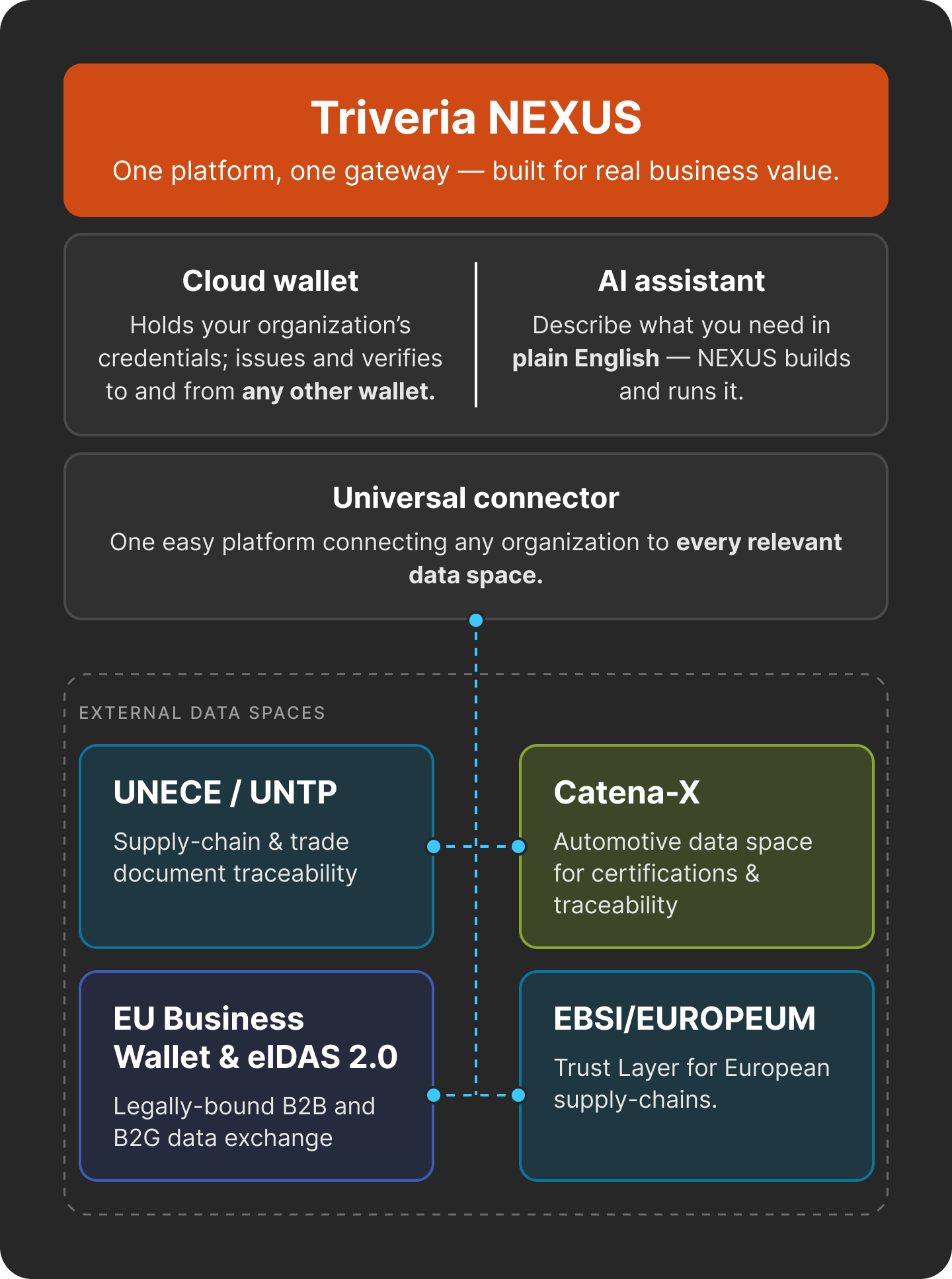
NEXUS is one gateway to the data spaces that regulation and industry have created: EU Business Wallets and eIDAS 2.0, EBSI/EUROPEUM, UNECE's UN Transparency Protocol and Catena-X. At its core is Triveria's digital identity and verifiable credential manager that can not only hold and verify claims and attestations but also act as an issuer. On top, NEXUS offers AI tooling, an MCP server and a knowledge base that keeps up with the rulebooks, so your own AI assistant has the precise knowledge of everything relevant and can control the credential interactions.
Whether your case is straightforward KYC — accepting a state-issued national PID and being done with it — or something built on the EU Business Wallet, where organisations present mandates, powers of representation and company attributes, you build against real credential formats and real trust frameworks, not a mock. And because a pilot on NEXUS is the complete implementation of the use case, going to production is a question of scope and assurance level, not a rewrite.
Every claim is cryptographically signed and verifiable.
Credentials are machine-readable from the moment they are issued.
Missing or expired data triggers a follow-up automatically, instead of landing in someone's inbox.
End-to-end digital flows: no PDFs, no email threads.
Integrates via REST API, webhooks and standard OAuth flows, and bridges verifiable credentials into your existing OAuth, OIDC and SAML services.
Connects EU trust frameworks (eIDAS 2.0 and the EU Business Wallet, EBSI/EUROPEUM, ETSI Trusted Lists) and global ones (UNECE UNTP, Catena-X), so one set of credentials works everywhere.
Runs on cloud, mobile and IoT: devices, sensors and vehicles hold and present credentials just like a person or organisation.
MCP server and knowledge base on top of the platform, so AI agents act within verifiable boundaries.
“Everything we failed to solve in the past decades bites back now.”
Agentic AI, non-human identities and quantum risk are turning long-standing identity gaps into urgent business problems.
These milestones are the first push. Each one creates an obligation that can only be met with verifiable data, and the businesses that build for it now will be ready for what follows.
Wherever trust needs to flow between companies, across borders or between data spaces, NEXUS replaces the manual checks.
Each supplier publishes a passport for its product. Before building, the manufacturer verifies the passport of every part on its bill of materials and collects the certificates behind the claims: published ones straight from the supplier, confidential ones on request and only with the supplier's consent. Invoices arrive as verifiable credentials too. The manufacturer then publishes its own passport, linked to every component it was made from, so any buyer can check the product and trace what it is made of. Built on the UN Transparency Protocol (UNTP) and W3C Verifiable Credentials, aligned with the EU ESPR and the European DPP standards EN 18216 and EN 18219 to 18223.
Suppliers declare their product footprints in the WBCSD PACT format, and an accredited auditor certifies how each one was calculated. When you ask for the data, the footprint, the audit certificate and the supplier's verified company identity arrive together in one signed answer and are checked on arrival. You work with audited primary data instead of conservative industry averages. Catena-X reports that using primary data instead of industry averages reduced PCF values by 46%.1
1 Catena-X, How Ford (OEM), Flex (Tier 1) and Micron (Tier 2) lower costs and reduce emissions with PCF reporting. Catena-X marks the 46% as a general figure from an internal case study.
Accept a state-issued national ID from an EU Digital Identity Wallet and verify a company through the EU Business Wallet. Then go one step further: the company checks its employee's ID and issues a power of representation (WE BUILD Power of X) straight to the employee's wallet. A bank, notary or business partner asks for ID and mandate in one request and checks that both name the same person, that the mandate really comes from the company and that it covers the act at hand. No PDFs to re-check, no calls to confirm. Built for banks and fintechs facing the eIDAS 2.0 deadline, and for any company onboarding customers or suppliers.
From February 2027 the EU Battery Regulation requires a digital passport for EV, light-transport and large industrial batteries. NEXUS builds it from evidence, not self-declaration: the carbon footprint comes from the supplier's audited PCF, responsible sourcing from the certificate the mine holds, due diligence from an independent provider's report and the manufacturer's identity from its Legal Entity Identifier. Every issuer is accredited on EBSI for exactly the credential it issues. Customers, recyclers and authorities verify the passport by the battery's serial number. Modelled on the EBSI TRACE4EU battery traceability scenario.
Your customers already issue invoices and documents from your software. Integrate NEXUS once through its REST API and webhooks, and they get product passports, carbon footprints, verified onboarding and battery passports without leaving your product or switching systems.
Explore the API →Triveria is a RegTech company building the infrastructure of the new EU trusted economy. We take active part in large-scale pilots, in the architecture, trust and wallet groups. We contribute to WE BUILD trust infrastructure specifications and collaborate on the Wallet Messaging Protocol, which lets wallets talk to each other directly so that systems can request, issue and verify credentials on their own. Our team brings 20+ years in IT (cryptography and PKI, automation and integration, R&D and solution architecture) and 4+ years across every major trust mechanism: EBSI, ETSI Trusted Lists, X.509 chains and DID registries.
We participate in the standards bodies, consortia and pilots that are shaping verifiable credentials — in Europe and beyond.
Active contributors to the Trust Infrastructure and Architecture Working Group within WE BUILD, co-authoring specifications for VC-based trust lists and bridging eIDAS X.509 identity with DIDs and Verifiable Credentials — in collaboration with IDunion SCE.
Part of the EBSI Vector Business Registries use case, issuing verifiable company registration credentials across member states. did:ebsi is listed among the identifiers in the European DPP standard EN 18249.
Collaborators on the Wallet Messaging Protocol, an open protocol that gives two wallets a secure, trusted channel to exchange credential offers, requests and presentations directly. It enables the next level of automation: systems find each other, ask for and verify the data they need and act on the result autonomously, with no person in the loop.
Also involved with UNECE / UN CEFACT, through the UN Transparency Protocol.